

Believe me, all I said to you
Believe me, all I did for you
All I did for you
All the time it takes to cut through
Live in doubt
Sometimes they keep you waiting
Look around
I’ve got a friend in here somewhere
Who can help me out
Believe me, all I said to you
Believe me, all I did for you
All I did for you, all I did for you— “Chosen Time,” New Order
Last weekend, while the United States of America turned 250 years old, I turned 28. Sharing this birthday is always interesting; I sometimes joke that I was born to be an American Studies scholar, came screaming into the world six weeks early right as the fireworks began splitting the sky in color. I have never known quite how to grapple with this legacy, how to attempt to celebrate myself while the rest of the country celebrates a place I find it often impossible not to hate. And yet, I continue to come back to study of this place. I am more creatively inspired by Americana than anything else—this hollow image, this blinders-on ideal that dictates so much of how we understand ourselves in both the country and the world and yet which is ultimately founded on so little. Nothing there there, not really. Collectively we do not yet know what to do with this absence, how to live with these ghosts. Some cling to the past, telling themselves a version of history that allows them to feel they exist still; others cling to despair, to a future of ruin. After all, all empires eventually fall, and the empire itself relies on a narrative mythology, a cultural production that masks and mirrors all at once. And me? I’m interested in unpacking that myth, in seeing who has controlled it, and where, and why. I am not interested in looking forward or backwards but rather in harnessing the proper tools to look around and see things clearly—a task that is becoming almost impossible in a world of digital tech, propaganda, and obstruction.
I am now both older than I have ever been and yet I have never felt more naive. I have read and studied more than I ever thought possible and I am struck constantly by the feeling that in fact I know nothing at all, that there is nothing left to say. This year, after falling back into a depression I thought I had left behind years ago, I began meeting with a therapist. Now I sit each week and am confronted with a question: do I feel this way because of a chemical imbalance within me or, as my therapist has pointed to, is it that the modern world is hot and lonely and difficult and expensive and getting worse all the time? It is neither, it is both, it is everything all at once. I have always felt too intensely; this open door of therapy has also opened questions of neurodivergence, of the ways in which I experience the world differently, of how I cling to certain stories through which to understand myself, to survive. Likewise, my writing practice has always emerged out of this desire: if there is no story through which to view myself through, then I must create it. And this is what has always been done: the world reflected through the stories we tell about it, the people shaped by their representations.
For the last month I have been mired in literature of the Great Depression. I read of long journeys, by foot and by wagon and by car, and think of the vast size of America, of how integral the notion of a journey is to our understanding of this country. Migration patterns criss-cross the entirety of North America. We are always looking for someplace else. In that elsewhere there is a different future: a possibility that we cling to, that we need desperately to believe in. This is a country that demands you believe in its mythos, its utopian vision, even as it offers so little in return. We are asked to subsist on promise alone, on the idea that we can start again, remake ourselves anew, or at least return ourselves to the past.
In Grapes of Wrath, first published in 1939, Steinbeck writes of migrants moving towards California, looking for the promised land: “But you can’t start. Only a baby can start. You and me—why, we’re all that’s been. The anger of a moment, the thousand pictures, that’s us. This land, this red land, is us; and the flood years and the dust years and the drought years are us. We can’t start again. The bitterness we sold to the junk man—he got it all right, but we have it still. And when the owner men told us to go, that’s us; and when the tractor hit the house, that’s us until we’re dead. To California or any other place—every one a drum major leading to a parade of hurts, marching with our bitterness. And some day—the armies of bitterness will all be going the same way. And they’ll all walk together, and there’ll be a dead terror from it.”
The road novel has always been quintessential to the American literary experience. When things get bad, we take to the road in search of something else. When things get good, we take to the road in search of more. We can never be satisfied, eating ourselves alive, spitting back out, and returning to chew again. The same highways, gas stations, fast food chains, hotels, no matter where you go.
I understand myself best when I am in flux, in movement. It is why I run, but it is also why I drive. The most creative periods of my life have overlapped the years where I commuted 2+ hours a day for work. I write best from life, and therefore I must go out and see the world up close, transmute it, and return it back to the world. I too am a snake eating my own tail. This year I have mostly isolated myself, hid inside my apartment in fear of the world. Creatively, it’s also been a weak year. I told myself I was just trying to make it through 27, what a fated number, to get to the other side of my late twenties in one piece. But I miss the world; I miss the road. I miss the billboards flashing by along the highway promising me that I can still be saved. I miss the scent of forest on a two-lane gravel road somewhere far away from the city. I miss the feeling of looking out and seeing strangers going about their daily lives, of feeling close to something even in a place where no one knows me at all. The anonymity of it all, the promise. I too cling to possibility.
And so, for my birthday this year, we drove. On a bit of a whim, T (my fiancé as of the last winter solstice, sorry for the lack of life updates, it’s been a weird year, etc etc) and I sketched out a route winding across North America: North Carolina to Detroit to Toronto to Niagara Falls to Binghamton to West Virginia to Roanoke and eventually back home. Almost 3,000 miles on our new car, a good 5-6 hours of driving every day, a route planned mostly around visiting family and old friends I wanted T to meet before our wedding next year. In his eyes, a trip for me to see people who I love and am loved by, to remember how it feels to be around people who know you intimately. And of course, because I decided to be born on the Fourth of July and not in mid-August as I was planned and expected to, this was also a road trip occurring around a few major national events: the US Men’s National Team in the World Cup, happening this year in North America (and how strange it is to see so many people wearing America-themed clothing and not have it feel like a political event; we rarely seem to get opportunities for nationalism that feel unifying), and America’s 250th birthday, which I had thought was mostly being taken as a cultural joke, but which I learned quickly, after crossing back over the American border and into Niagara Falls on the last day of June, plenty of people were taking quite seriously, with themed t-shirts, bumper stickers, and plenty of America 250 flags flying from the front porches of houses across upstate New York, Pennsylvania, and Maryland, as we wound our way back down South in the days leading up to the Fourth of July.
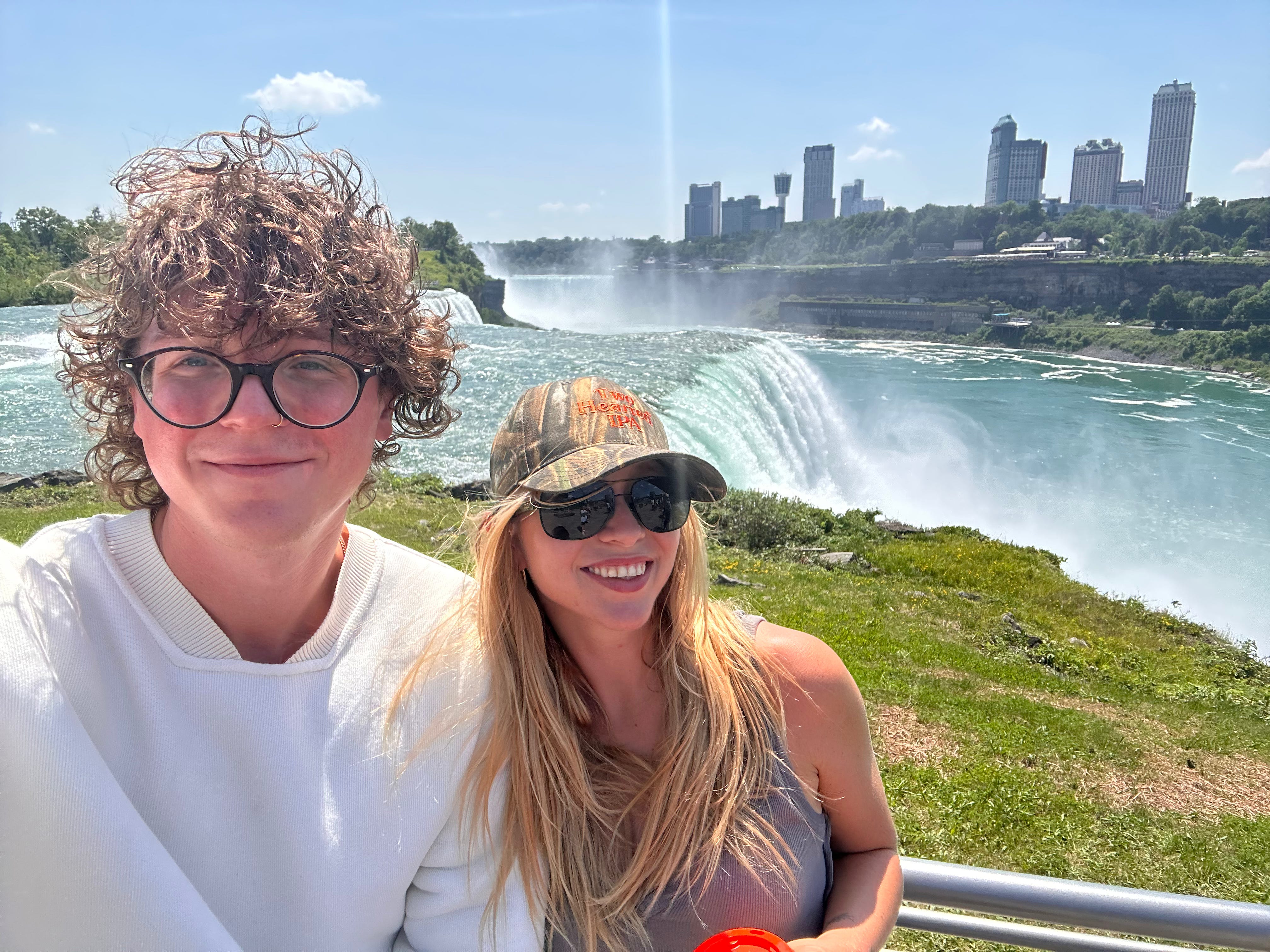
There is no better way to experience the country than by road (I could be swayed into train supremacy, but we’d need to expand the Amtrak system first). In West Virginia we eat dinner in the parking lot of a Chick-Fil-A and look out at sunset over the distant mountains, so beautiful even when crossed with powerlines and chimneys of smoke from the factory next to us. In Ohio a tattooed young woman on a motorbike fills up her gas tank at the pump next to us and we follow one another through the dark until we peel off in Toledo. In Michigan the rain starts, pounding on the roof of our car, blinding us in the night. In Pennsylvania, I watch as a young Amish boy runs to the end of his driveway to wave at passerby. In Ontario, we stop off somewhere random for poutine and I observe the elderly couple at the picnic table next to us, sitting quietly as they eat together. On the 71st floor of my friend’s apartment building, I lean over the balcony and look out at the sprawl of Toronto, illuminated by the full moon as it rises over the water. The next morning, from above, I spy a dance troupe in a park below, waving silk scarves in the air. From up here everything looks so small, the same way it does when I drive past it on the road: fleeting, momentary, gone before I can even attempt to grasp. We sit in the park in the evening, laid out in the grass, and listen to people singing. I am alive with the world, drunk on this feeling of community. We pick raspberries in upstate New York during a heatwave and grill steaks with old friends, setting alarms for the next morning’s pre-dawn, where we will rise and drive again. Much like backpacking, there is a rhythm to the road trip, a space you fall into. It is one of the few times in my life that I do not feel anxious; I cannot be anywhere else other than where I am. I am not thinking about the future, or really even about the past. I am just in it. I am just there.


Lately I have been thinking about how we can better consider America not just as the United States but rather as the broader North American continent. Partly this is inspired by the current World Cup, but it is also there in my current research on the politics of regional representation. American literature tends to split perspectives into North/South/West and then views itself internally, forgetting that it is also North/South/West to the world. As John Jeremiah Sullivan wrote in my introduction to Absalom, Absalom! of the importance of Quentin’s Canadian roommate, “All of America is a south to Shreve.”
Seven years ago, I turned 21 in Canada, where I was living and working in rural Ontario. It felt I had waited my whole life to turn 21, and, of course, in Canada, where the drinking age is 19, it hardly mattered at all. I rode on a yellow school bus into town and drank beers at the local tavern and went to Wal-Mart to buy a pillowcase for the cot I slept on all that summer. In Canada, I was the only American amongst my friend group, and I learned quickly that us Americans are not often used to being the only one, that somewhere along the way we came to see ourselves as the cultural default. Everyone else has an accent, everywhere else is a place you visit, every piece of media should be made originally in or translated into English. Our worldview is so limited; we are stuck in our own hegemonic circle and we cannot see outside of it. And what are we promoting, what we are protecting? I have lived in five countries throughout my twenties and in all of them I was treated with more kindness, empathy, and welcome than I have ever experienced anywhere in America. This is a harsh place: severe landscapes, rigid worldviews, rugged individualism that is sold to us as opportunity but relies on isolation and cruelty.
Early American writers speak often of wilderness, of their desire to conquer the land and find an authentic spirit in themselves through the act. Last summer, while backpacking through Montana’s Beartooth Range, I read Lauren Groff’s The Vaster Wilds, set in 17th century America and following a young servant girl as she flees into the wilderness and discovers both the cruelty and salvation of the American expanse. At the end of her story there is not salvation but rather an acceptance of the harshness inherent to this place:
“For there was nothing there, no angels, no harps, no gates, no fires singeing the sins back into the sinner, no hungry spirits wandering the land and standing in the cold outside the firelight of the living. There was only wind drawing itself endlessly over the dark crowns of the pines, over the face of the water, over the mountain’s icy peaks, over the great wide golden stretches of the teeming land. The wind passed, even as it is passing now, over all the people who find themselves so dulled by the concerns of their own bodies and their own hungers that they cannot stop for a moment to feel its goodness as it brushes against them. And feel it now, so soft, so eternal, this wind against your good and living skin.”
What can authenticity look like for America if it is not founded on individualism? What—if any—communal visions can come to fill this space of the American Dream as it hollows out and falls back into the distant past? What new ways can we understand ourselves, not only as individual Americans but rather as a communal unit that must move, breathe, and feel the wind together if we wish to survive?
We ended our trip with a 3-day backpacking loop through the Dolly Sods Wilderness in West Virginia, a new trail for both T and I. There was a heat wave the entire time, 100+ degree temperatures, and more humid than any backpacking trip I have done, the air thick inside the forest. At every campsite, I could hear the sounds of our neighbors, comforting in the wilderness: a child’s laugh, someone’s dog barking, the crackling of a fire being lit. On the morning of my birthday, I woke early and jumped in the creek, the water cold in the dawn. I put my head under the waterfall and let the sound rush over me, tuning out everything else. Here, now. If you believe in nothing else believe in this. Today I will walk many miles, for pleasure as much as for purpose, and I will return the place where I began. I am in a circle even if I am different now. I can’t start again, but I can carry with me all the places I have been and all the people I have loved within them. I can become fragmentary in an important, necessary way; I can learn to exist outside of my own experience. If love—and travel—has taught me anything, it is this.


I have been practicing breathwork this summer, sitting in silence for ten minutes each morning while I re-learn how to do the simple act of inhaling and exhaling. It was pointed out to me recently that I do not breathe properly through my diaphragm, only taking short breaths, just enough to survive. On my porch in the early mornings I attempt to fill my chest with it, feel my ribs crack and ease inside of me. It feels like learning how to live in tension, something like watching the most beautiful sunset I have ever seen in a town overrun with poverty, depression, and isolation. It feels something like the touch of someone I love deeply after many years. It feels something like the rush of cold water and slick rocks, the way all the breath goes out of me in one fell swoop when I dive fully under the depths. It feels something like the uphill slog of the mountains, never ending, full of false summits and fleeting moments of hope where I think this time it will be it, this time it will be over, and it just keeps on going. If I have learned anything this year it is to just keep on going. Keep on driving, keep looking for a different curve in the road, an exit sign that will take me somewhere else, for however long, only to eventually turn me in a circle, back towards home.
Other Things:
As noted in the beginning, I’ve had this album by New Order heavily on repeat through much of this road trip.
I’ve also been pretty obsessed with this song by Death in Vegas. Played this on a loop for hours and hours this week while reading. Hypnotic in the best way.
Likewise, LCD Soundsystem’s North American Scum for the 4th, because of course.
Picked up Frances Fitzgerald’s Cities on a Hill: A Journey Through Contemporary American Cultures this week on a rec from my advisor. I’ve yet to receive, but I’m excited to dig into her exploration of utopian communities and their reflection of the “American Dream.”
T got me new airpods for my birthday after mine broke sometime last year. Maybe it’s the newly discovered neurodivergence thing, but oh my god, I can’t believe how I lived without these for so many months. I’m suddenly getting so much work done now that I can tune the world out.
I picked up this 8oz Yeti mug to make to-go cortados in for my commute to work. It’s cute and tiny and I’m suddenly getting a crazy amount of compliments on my mug from strangers. If you like strong espresso this is basically a perfect cup. Hot coffee all summer long!
"I am more creatively inspired by Americana than anything else—this hollow image, this blinders-on ideal that dictates so much of how we understand ourselves in both the country and the world and yet which is ultimately founded on so little." is going straight into the notebook, love this one.